
How to Tell If Hair Extensions Are Real Human Hair
- Hair Extensions
-
Aug 21
-
12 min read
- Share post
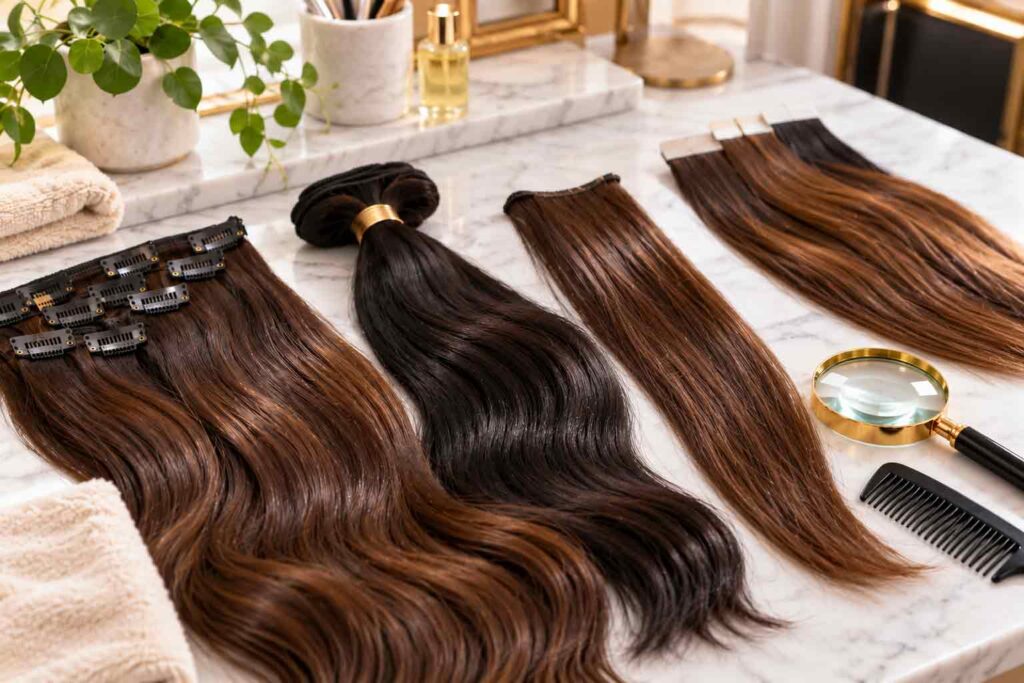
How to Tell If Hair Extensions Are Real Human Hair
Buying hair extensions online can involve an extraordinary amount of trust.
A website shows you glossy bundles cascading over somebody’s shoulder, tells you they are 100% premium human hair, adds the words luxury, silky and virgin for emotional support, and then asks for your card details.
Lovely.
But how do you actually know whether the hair extensions arriving at your door are real human hair?
The most important thing to know is this: there is no single foolproof home test that can prove the full composition or history of a set of hair extensions. Good-quality synthetic fibres can look remarkably similar to human hair, and poor-quality human hair can look suspiciously artificial.
So instead of relying on one dramatic internet trick, use several clues together.
What Does “Human Hair Extensions” Actually Mean?
Human hair extensions are made from real human hair rather than manufactured synthetic fibres.
That sounds obvious, but the hair market contains several different products.
You may come across:
- Human hair extensions
- Remy human hair
- Virgin human hair
- Raw human hair
- Human hair blended with synthetic fibres
- Heat-resistant synthetic extensions
- Standard synthetic extensions
These are not interchangeable terms.
For example, Remy generally refers to human hair where the strands have been kept aligned in the same root-to-tip direction.
Virgin hair generally refers to human hair that has not previously been chemically coloured, bleached, permed or relaxed.
Neither word should be treated as a magical certificate of perfection.
And “human hair blend” is particularly worth reading carefully because the word human may be doing quite a lot of work in that sentence.
Start With the Product Description
Before performing your own episode of Hair CSI, go back to the original listing.
What exactly did the seller promise?
Look for phrases such as:
100% human hair
That is different from:
human hair blend
or:
human hair feel
“Human hair feel” is particularly creative.
My sofa has a leather feel. It is still not a cow.
If the listing is vague about the fibre content, ask the seller directly.
Useful questions include:
- Is this 100% human hair?
- Is any synthetic fibre mixed into it?
- Is the hair Remy?
- Has the hair been chemically processed?
- Can heat tools be used on it?
- Can it be coloured or bleached?
- What temperature limits apply?
- What is your returns policy if the product is not as described?
Save the answers.
If there is later a dispute about what you received, having the original listing and written communication can be useful.
Look at the Individual Hair Strands
Real human hair is naturally imperfect.
Individual strands can vary slightly in:
- thickness
- colour
- texture
- wave pattern
- diameter
That doesn’t mean a human-hair extension should look messy. Good manufacturing can produce beautifully consistent bundles.
But hair that looks suspiciously identical from strand to strand may deserve closer inspection.
Synthetic fibres are manufactured, so they can be extremely uniform.
However, this clue alone proves nothing.
Modern synthetic hair can be deliberately manufactured to look more natural, while heavily processed human hair can look extraordinarily uniform.
Basically, even the hair has learnt how to catfish.
Pay Attention to the Shine
Some synthetic extensions have a very noticeable plastic-like shine, especially under bright light.
Human hair generally reflects light in a softer and less uniform way.
But again, don’t make a court case out of shine alone.
High-quality synthetic fibres can have a very realistic finish. Human hair can also be coated with conditioning products or silicones that make it look unusually glossy when first removed from the packaging.
That luxurious first-day shine may therefore tell you less than you think.
The real questions often begin after washing.
See How the Hair Moves
Human hair tends to move in a natural, irregular way because individual strands behave slightly differently.
Some synthetic fibres can appear stiffer or move together in sections.
But quality matters enormously.
High-quality synthetic hair can have impressive movement, while badly processed human hair can feel stiff, coated or unnatural.
So movement is another clue, not proof.
If you find yourself waving a bundle around the bedroom for 20 minutes trying to establish its citizenship, it may be time to move on to the next test.
Check How It Feels
Run your fingers gently through the hair.
Human hair commonly has tiny natural variations in texture.
Synthetic fibre can sometimes feel:
- unusually smooth
- slightly plastic
- overly slippery
- stiff
- extremely uniform
But modern synthetic hair is designed specifically to overcome these problems.
Some synthetic extensions feel excellent.
And some human hair feels terrible.
Price and marketing do not change biology.
What Happens After Washing?
This is often more revealing than looking at hair straight out of the packet.
Some extension hair is coated during manufacturing to give it a smooth, shiny finish.
After washing, that coating may reduce and the hair’s actual behaviour becomes clearer.
You may notice changes in:
- natural texture
- frizz
- wave pattern
- softness
- tangling
- shine
- movement
Human hair may behave more like naturally growing hair when washed, although its behaviour will also depend on previous chemical processing.
Synthetic fibres usually retain the texture that was manufactured into them, although different fibre types react differently.
Always follow the manufacturer’s washing instructions.
Do not wash the hair immediately if doing so would prevent you returning it.
Read the returns policy first.
Nobody wants to discover the truth about their extensions and simultaneously discover that they have voided the return.
Can You Use Heat to Test Human Hair?
Be careful with this one.
Human hair can normally tolerate controlled heat styling, although excessive heat can still damage it.
Some synthetic hair will melt, distort or become damaged under temperatures that human hair can tolerate.
But modern heat-resistant synthetic fibres complicate this enormously.
Some synthetic extensions are specifically designed to work with straighteners or curling tools within particular temperature limits.
So:
Hair surviving a straightener does not prove it is human hair.
And deliberately applying extreme heat to find out what happens is a very efficient way of potentially ruining something you have already paid for.
Follow the product’s temperature instructions instead.
If you are uncertain, test only an inconspicuous section and stay within the manufacturer’s stated limits.
What About the Famous Burn Test?
You’ve probably seen this recommended online.
The basic idea is that human hair and synthetic fibres behave differently when burned.
I would not recommend setting your extensions on fire at home as an identification method.
Apart from the obvious fire risk, burning synthetic materials can produce unpleasant fumes, and blended products can make the results difficult to interpret anyway.
Even if something burns in a particular way, that doesn’t tell you whether the entire product contains the same fibre.
Your £300 bundles do not need to participate in a small household bonfire to prove themselves.
There are safer ways to investigate.
Can Human Hair Be Coloured?
Generally, genuine human hair can be chemically coloured because it contains the same structural materials as naturally growing human hair.
Synthetic fibres usually require different colouring methods, and traditional oxidative hair colour designed for human hair may not work properly on them.
But this is not a sensible identification test.
Why?
Because human extension hair may already have been heavily processed.
Previously bleached or coloured hair may react badly to further chemical treatment.
Some products sold as human hair may also contain mixed fibres.
So don’t bleach a £400 set of extensions purely to see if they’re telling the truth.
That’s less of a test and more of a financially aggressive science experiment.
Look Closely at the Ends
Human hair naturally varies slightly towards the ends.
Depending on the product and how it has been prepared, you may see small differences in strand length and density.
Extensions that have been heavily trimmed or manufactured to create very full ends can still look extremely uniform.
So the ends can provide information about construction and fullness, but they cannot prove the fibre is human.
This is particularly important with terms such as single drawn and double drawn.
Those describe how hair lengths within a bundle are sorted and distributed. They do not independently prove that the hair is genuine.
What Does the Hair Smell Like?
Fresh human hair extensions can have smells from packaging, washing, conditioning or manufacturing.
Synthetic products may sometimes have a more noticeable manufactured or plastic-type smell.
Unfortunately, your nose is not a laboratory.
A fragrance, coating or treatment can completely change how either product smells.
So please don’t stand in your hallway sniffing a bundle and announcing, “Definitely Cambodian.”
The evidence does not support that level of confidence.
Check the Weft and Construction
Look at how the extensions are made.
For wefted hair, examine:
- stitching
- loose strands
- thickness
- shedding
- consistency
- overall construction
For clip-ins, inspect:
- clips
- stitching
- attachment points
- fibre density
Poor construction does not prove the hair is synthetic, but it can tell you plenty about overall quality.
Remember, real human hair and good-quality hair extensions are not automatically the same thing.
A product can contain genuine human hair and still be badly made.
Independent Reviews Are Extremely Useful
Before buying, look beyond the reviews displayed directly underneath the vendor’s Buy Now button.
Search for independent experiences.
Useful reviews discuss things such as:
- what the hair looked like after washing
- whether it tangled
- whether it shed
- whether it accepted heat styling as advertised
- how it behaved over time
- whether the length was accurate
- whether the ends were full
- whether the vendor responded to problems
Photographs taken after several wears can often be more informative than a perfect unboxing photograph.
The hair has had time to reveal its personality by then.
Be Careful With Price
Very cheap extensions marketed as premium human hair deserve scrutiny.
Real human hair requires collection, sorting, processing, manufacture and distribution. That has a cost.
But the opposite is also true.
An expensive price does not prove that something is genuine human hair.
A company is perfectly capable of charging a lot of money for something questionable.
Luxury pricing is not forensic evidence.
Neither is beautiful packaging.
Neither is a large Instagram following.
Neither is a woman slowly running her fingers through the hair while soft music plays in the background.
Very persuasive.
Still not laboratory analysis.
The Best Way to Judge Human Hair Extensions
Rather than relying on one home test, look at the complete picture.
Before buying, check:
- Does the seller clearly state the fibre content?
- Does it specifically say 100% human hair?
- Is synthetic fibre mentioned anywhere?
- Is the company clear about processing?
- Are there genuine independent reviews?
- Are customer photographs available?
- Does the hair behave as described?
- Is there a proper returns policy?
- Will the company answer detailed questions?
- Does the price and description make sense?
And once the hair arrives, inspect it before cutting, colouring, washing or installing it if those actions could affect your return rights.
Real Human Hair Shouldn’t Require Blind Faith
There is no magical five-second trick that can reliably prove everything about a set of hair extensions.
Your strongest protection is a combination of careful shopping, clear product descriptions, independent reviews, sensible inspection and a vendor willing to answer straightforward questions.
If something is advertised as 100% human hair, you should be receiving what was advertised.
And if the seller cannot tell you whether their “100% premium luxury human hair” contains synthetic fibre, but can somehow tell you it will “transform your energy”, perhaps keep your card in your purse.
Your energy will survive.
Comments
Add a comment
Leave a Reply · Cancel reply
You must be logged in to post a comment.
