
The Difference Between Raw Hair and Virgin Hair
- Buying Guides
- Hair Extensions
-
Sep 12
-
11 min read
- Share post
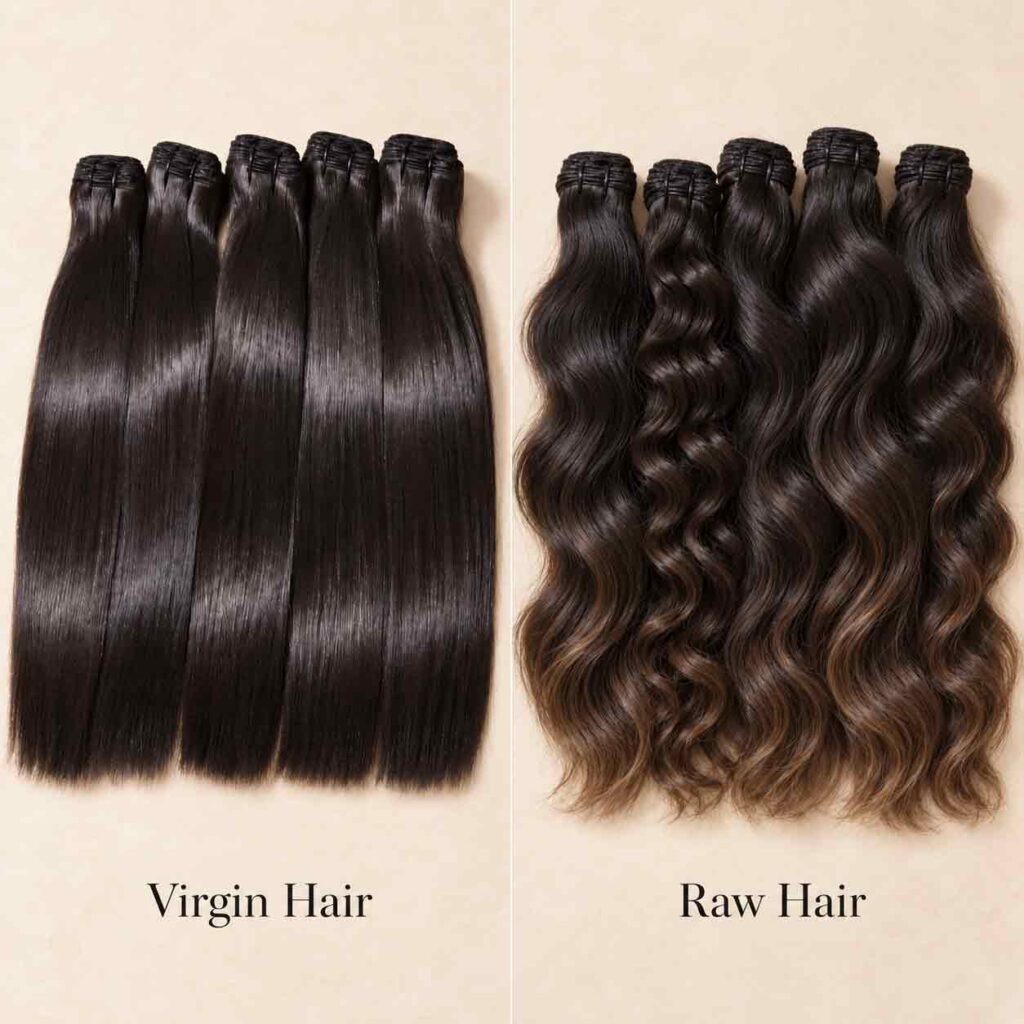
What Is Raw Hair and How Is It Different From Virgin Hair?
Shopping for hair can feel less like buying extensions and more like sitting an exam you were never told you had.
Raw hair. Virgin hair. Remy hair. Single donor. Double drawn. 12A. Premium. Luxury. Super premium luxury.
At some point, you half expect a bundle to arrive with its own CV.
The important thing to understand is that raw hair and virgin hair are both terms used to describe human hair with little or no chemical alteration, but they are not necessarily the same thing. Raw hair is generally sold as being in a more natural, minimally processed state, while virgin hair is generally understood to mean human hair that has not previously been chemically coloured, bleached, permed or relaxed.
The complication is that there is no single universal grading or naming system used by every hair vendor. So the name on the packet is useful, but it should never be the only thing you rely on.
What Is Raw Hair?
Raw hair is generally marketed as human hair that has undergone very little processing and remains close to the state it was in when collected.
Typically, sellers describing hair as raw mean that it has not been:
- Chemically coloured
- Bleached
- Chemically straightened
- Permed
- Chemically altered to create a different texture
Raw hair will usually retain the natural characteristics of the original hair, including slight variations in colour, texture and wave pattern.
And that variation is important.
Real human hair does not necessarily come off somebody’s head looking like 12 identical bundles lined up for military inspection.
One bundle may have a slightly looser wave. Another might have a tiny difference in shade. Natural variation is normal.
That does not automatically prove something is raw, of course, but perfectly identical hair across huge quantities should at least encourage you to ask a few more questions.
What Is Virgin Hair?
Virgin hair generally refers to human hair that has not previously been chemically treated with processes such as permanent colouring, bleaching, relaxing or perming.
The key difference is that virgin hair may still undergo certain manufacturing or preparation processes before it reaches you.
For example, depending on the supplier, it may be washed, conditioned, sorted or prepared to create a consistent finished product.
Some vendors may also use processes such as steam to create particular textures while continuing to market the hair as virgin.
This is where things become slightly messy.
Two companies can both sell something labelled “Virgin Body Wave”, yet their manufacturing processes may be completely different.
So when a website says:
100% PREMIUM VIRGIN HUMAN HAIR
don’t immediately hear trumpets.
Ask what they actually mean by it.
Raw Hair vs Virgin Hair: What’s the Main Difference?
The simplest way to understand it is this:
Raw hair is generally sold as being as close as possible to its natural collected state.
Virgin hair generally means human hair that has not previously undergone major chemical treatments such as colouring, bleaching, perming or relaxing.
Raw hair is therefore usually marketed as the less processed of the two.
But these descriptions are not controlled by one worldwide hair authority.
There is no international Hair Police Department kicking factory doors down shouting, “Step away from that Brazilian Body Wave!”
Different suppliers can use the terminology differently.
That is why knowing what questions to ask is more useful than memorising definitions.
Does Raw Hair Always Come From One Donor?
Not necessarily.
You will often see raw hair advertised alongside the phrase single donor, but the two terms do not automatically mean the same thing.
Single donor means the seller is claiming that the hair in a particular bundle or product came from one person.
Raw describes how the hair has been processed, or more accurately, how little it has supposedly been processed.
So you could potentially have raw hair that is single donor, but you should not assume that every product labelled raw automatically comes from one donor.
If single-donor hair matters to you, ask specifically.
What About Remy Hair?
Here comes another member of the hair vocabulary family.
Remy hair generally refers to human hair where the strands have been kept aligned in the same root-to-tip direction.
Hair has an outer protective layer called the cuticle. Keeping the strands running in the same direction can help reduce friction between opposing cuticles and may help the hair behave more naturally.
But Remy does not automatically mean raw.
And Remy does not automatically mean virgin.
Hair could potentially be:
- Raw and Remy
- Virgin and Remy
- Remy but chemically coloured
- Human hair without being Remy
So if a vendor tells you, “It’s Remy”, that answers one question.
It does not answer all seventeen others.
Is Raw Hair Better Than Virgin Hair?
Not automatically.
Raw hair can be highly desirable because it is generally sold as having undergone minimal processing. However, the word raw is not a guarantee that you will receive amazing hair.
Quality also depends on things such as:
- The condition of the original hair
- How it was collected
- How the strands were sorted
- Whether the cuticles remain aligned
- How the wefts were constructed
- The fullness of the ends
- Storage and manufacturing
- How accurately the seller has described the product
A badly constructed bundle does not become magnificent because somebody called it raw.
That’s like putting “artisan” in front of a burnt biscuit.
The biscuit knows what happened.
Virgin hair can also be excellent quality. A reputable supplier with good sourcing, careful manufacturing and accurate descriptions may sell virgin hair that performs far better than questionable hair wearing the raw label like a designer handbag.
Why Does Raw Hair Often Look Less Uniform?
If the texture has not been manufactured into an identical pattern, genuine natural hair may have variations.
A natural wave may be stronger in one section and softer in another.
Colour can also vary slightly because naturally occurring human hair is not produced according to a paint chart.
This can actually be part of the appeal of raw hair. Some people prefer the more natural appearance and variation.
Others want something extremely consistent.
Neither preference is wrong.
If you want four bundles with almost identical curls, a manufactured texture may actually suit you better than a naturally varying raw texture.
Buying the most expensive option simply because the internet has announced it is “the best” is how people end up spending £600 and then staring at the parcel like it personally betrayed them.
Can Raw and Virgin Hair Be Coloured?
Human hair can generally be coloured, but colouring and especially bleaching alter the hair.
That means if you buy genuinely untreated hair and then chemically colour it, you have changed its original untreated condition.
How well hair handles colouring depends on several factors, including its existing condition and any previous treatment that may not be obvious to you.
If you’re planning a significant colour change:
- Ask the vendor about the hair’s processing history
- Read its colouring instructions
- Test a small section first
- Be particularly careful with strong lightening or bleaching
- Consider using an experienced professional
And remember, “human hair” does not mean “indestructible hair”.
It is hair, not kitchen worktop.
Is Hair From Certain Countries Automatically Better?
No.
You will see hair sold as:
- Vietnamese
- Indian
- Cambodian
- Burmese
- Brazilian
- Peruvian
- Malaysian
- Russian
- European
These names may refer to genuine origin in some cases, but geographic terminology is also used inconsistently within the hair industry.
A country name by itself does not tell you everything about quality.
Hair quality depends on far more than geography.
If a vendor claims a particular origin and that origin is important to your decision, ask what supports the claim.
Don’t assume a bundle has personally flown in from Rio because somebody typed “Brazilian” in 42-point gold lettering.
What Should You Ask Before Buying Raw Hair?
If you’re paying raw-hair prices, ask raw-hair questions.
Has the hair been chemically treated?
Ask specifically about colouring, bleaching, relaxing and permanent texture alteration.
Has the texture been altered?
If you are buying a particular curl or wave, ask whether that texture is naturally occurring or has been created.
Is the hair Remy?
Ask whether the strands are kept in consistent root-to-tip alignment.
Is it single donor?
If the seller makes this claim, ask whether it applies to each individual bundle or to the product range generally.
What exactly does the vendor mean by “raw”?
This might be the most useful question of all.
A good seller should be able to explain its terminology without performing verbal gymnastics.
Can you see the hair after washing?
Fresh bundles can be very impressive.
The real interview begins after shampoo.
Look for independent customer photographs and reviews showing how the hair behaves after being washed, worn and maintained.
Don’t Let Hair Grades Distract You
You may see raw or virgin hair advertised as 10A, 12A or another numerical grade.
These grades are not a universal quality standard shared by every hair company.
One vendor’s 12A can mean something completely different from another vendor’s 12A.
A larger number does not automatically mean the hair has climbed further up some international hair-ranking ladder.
Ask for useful information instead.
How much does the bundle weigh?
How full are the ends?
What treatment has the hair undergone?
Is it cuticle aligned?
What is the returns policy?
What are verified buyers saying after wearing it?
Those answers will usually tell you much more than a mysterious letter A.
Which Should You Buy: Raw or Virgin Hair?
Choose according to what actually matters to you.
Raw hair may appeal if you want hair marketed as being very close to its natural state and you are comfortable with natural variations in texture and colour.
Virgin hair may offer more choice in consistent textures and styles while still avoiding major previous chemical processing, depending on how the particular supplier defines and manufactures it.
Neither label should make the decision for you.
Look at the hair itself, the seller’s transparency, independent customer experiences, specifications, returns policy and the answers you receive when you ask questions.
Because the biggest lesson in buying raw hair versus virgin hair is surprisingly simple:
Buy the hair, not the vocabulary.
A vendor can put “Raw Virgin Premium Luxury Single Donor Supreme Elite Hair” across the website if they fancy.
Your job is still to ask what is actually inside the bundle.
And if nobody can give you a straight answer, your bank card is allowed to remain exactly where it is.
Comments
Add a comment
Leave a Reply · Cancel reply
You must be logged in to post a comment.
