
What is Virgin Hair
- Buying Guides
- Hair Extensions
- Hair Guide
-
Sep 21
-
16 min read
- Share post
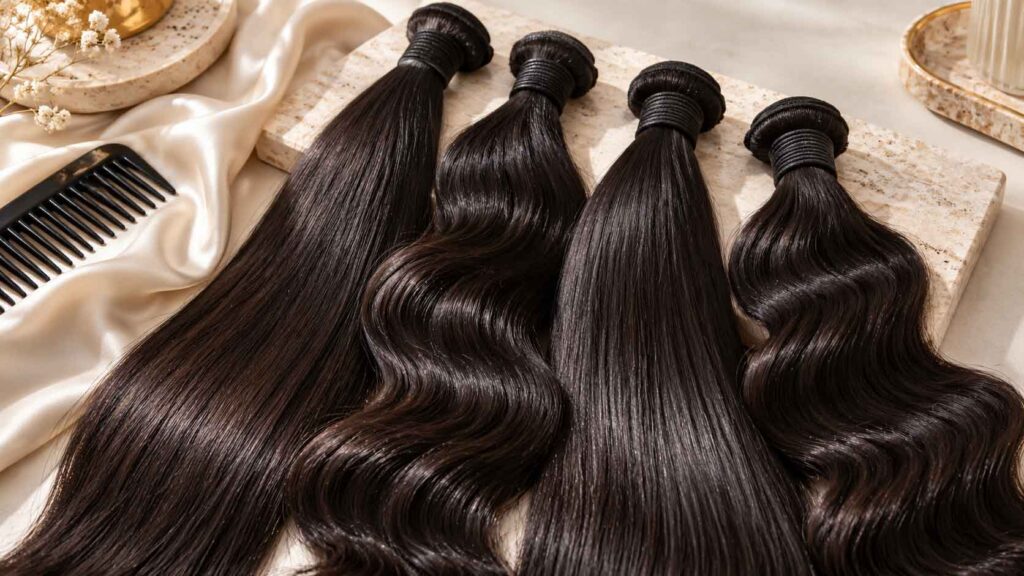
What Is Virgin Hair? A Beginner’s Guide
Buying hair extensions should feel simple. You choose the length, texture and style you like, place your order and wait for your new hair to arrive.
Then you start shopping.
Suddenly you see virgin hair, raw hair, Remy hair, single-donor hair, double-drawn hair, 10A hair, 12A hair and endless versions of “premium”.
Before long, buying three bundles starts to feel like an exam.
One term appears more than almost any other: virgin hair.
So, what is virgin hair? What makes it different from other human hair extensions? Is virgin hair always high quality? And what should you check before spending your money?
Here is what you need to know.
What Is Virgin Hair?
Virgin hair generally refers to real human hair with no previous permanent chemical colouring, bleaching, perming, relaxing or chemical texture alteration.
In scientific hair research, researchers regularly use the term virgin hair when referring to untreated hair. They compare virgin hair with bleached, coloured or chemically straightened hair to examine the effects of chemical treatments on the hair fibre.
The hair-extension industry uses the term in a similar way.
Virgin human hair usually means hair with no previous:
- Bleaching
- Permanent colouring
- Chemical relaxing
- Perming
- Permanent chemical straightening
- Chemical texture alteration
There is an important detail to understand.
Virgin does not necessarily mean nothing has happened to the hair since collection.
Human hair extensions still need cleaning, sorting and preparation. The hair also needs turning into bundles, wigs, closures, frontals or another finished product.
Some suppliers use virgin to describe hair with no previous chemical alteration to its colour or natural texture, even if the hair received other preparation during manufacturing.
This is why the words “100% virgin hair” on a product page do not give you the full story.
Instead of asking only:
“Is this virgin hair?”
Ask:
“What processing has this hair undergone?”
You are far more likely to receive useful information.
What Does Unprocessed Virgin Hair Mean?
The word “unprocessed” causes plenty of confusion.
When sellers describe virgin hair as unprocessed, they usually mean the hair has not undergone major chemical treatments designed to permanently change its natural colour or texture.
It does not necessarily mean the hair travelled directly from a donor’s head into your parcel without cleaning, sorting or manufacturing.
Ask the seller whether the hair has been:
- Dyed
- Bleached
- Lightened
- Chemically straightened
- Chemically curled
- Acid-treated
- Silicone-coated
- Steam-textured
- Chemically altered in another way
The answers matter more than the word “unprocessed”.
A reputable hair vendor should explain what its terminology means and what treatments its products have received.
Why Does Chemical Processing Matter?
Human hair has several structural layers.
The cuticle forms the protective outer surface of the hair shaft. Beneath it sits the cortex, which makes up a large part of the hair fibre and contributes to its strength and other physical properties.
Chemical treatments affect these structures.
Research comparing untreated hair with chemically treated hair has found changes and damage following treatments such as bleaching and chemical straightening.
Bleaching places particular stress on hair fibres. More intensive bleaching increases the risk of structural damage and protein loss.
This does not make all processed human hair poor quality.
Processed hair might suit you perfectly if you want platinum blonde, red, highlighted or specially textured extensions.
The important issue is transparency.
You should know what happened to the hair before you bought it.
If a bundle started dark brown and arrived platinum blonde, it did not get there through positive thinking.
Something happened during processing.
Does Virgin Hair Have to Be a Natural Colour?
Natural human hair comes in different colours and shades.
If hair has been permanently chemically coloured or bleached before sale, describing it as completely untreated virgin hair becomes difficult to reconcile with the usual meaning of virgin hair.
Pay attention when a seller advertises hair as virgin, completely unprocessed and heavily colour-altered at the same time.
Ask how the colour was achieved.
A trustworthy vendor should explain whether the hair has been coloured, lightened or chemically altered.
Virgin Hair vs Remy Hair
Virgin hair and Remy hair are often treated as if they mean the same thing.
They do not.
Virgin hair refers mainly to processing history.
The question behind the term is:
Has the hair previously undergone permanent chemical alteration?
Remy hair refers mainly to the alignment of the hair strands.
With Remy hair, the strands are generally collected and kept in the same root-to-tip direction so the cuticles remain aligned in a consistent direction.
This matters because the hair cuticle has overlapping structures. Keeping strands aligned helps reduce unwanted friction between hairs.
Hair therefore might be:
- Virgin and Remy
- Remy and chemically processed
- Human hair without being Remy
- Described as virgin without enough information to establish whether it is Remy
An easy way to remember the difference is:
Virgin describes treatment.
Remy describes alignment.
Neither word provides a complete quality assessment on its own.
Virgin Hair vs Raw Hair
Raw hair creates another layer of confusion.
Within the hair-extension market, raw hair is usually sold as human hair in a more natural state, with minimal processing and its original texture and colour retained.
Scientific research examining hair-extension products has also identified a distinction between products marketed as raw human hair and virgin human hair.
Raw hair is often marketed as completely unprocessed. Virgin hair is generally described as having no chemical dyeing, bleaching or texture modification.
The problem is consistency.
Different suppliers use these terms differently.
There is no universal hair-grading system forcing every vendor to use “raw” and “virgin” in exactly the same way.
If a company sells both raw and virgin hair, ask what separates the two ranges.
Useful questions include:
- Has either range received chemical treatment?
- Has the colour changed?
- Has the texture changed?
- Has the hair been steam-textured?
- Are the cuticles intact and aligned?
- Is the hair Remy?
- Is the hair single donor?
- What treatments took place after collection?
Specific answers tell you more than luxury-sounding product names.
Does Virgin Hair Mean Single Donor?
No.
Virgin hair and single-donor hair describe different things.
Virgin relates to processing history.
Single donor relates to sourcing.
A single-donor claim means the seller says the hair within a particular product came from one individual donor.
Virgin hair does not automatically come from one donor.
Some vendors sell single-donor virgin hair or single-donor raw hair. In those cases, the seller is making more than one claim about the product.
If donor count matters to you, ask the vendor directly.
Do not assume “virgin” also means “single donor”.
Is Virgin Hair Always High Quality?
No.
This is one of the most important points to understand before buying virgin hair extensions.
Virgin describes one characteristic of the hair. It does not provide a complete quality rating.
The word virgin alone does not tell you:
- Whether the cuticles are aligned
- How carefully the hair was collected
- How well it was sorted
- How full the ends are
- Whether the lengths are accurate
- How well the wefts were constructed
- How much shedding you might experience
- How easily the hair tangles
- What happened during manufacturing
- How the hair performs after washing
- Whether the vendor describes its products accurately
- What standard of customer service you will receive
Two vendors might both sell products described as virgin human hair while offering noticeably different quality.
The label tells you something. It does not tell you everything.
What Do 8A, 10A and 12A Hair Grades Mean?
You will often see virgin hair advertised using grades such as:
- 8A
- 9A
- 10A
- 12A
- 13A
These numbers look official.
They are not a universal independent grading standard.
Hair suppliers use their own grading systems, which means one company’s 10A hair does not automatically match another company’s 10A hair.
A larger number does not prove better hair.
Instead of relying on the grade, ask questions with useful answers.
Find out:
- Is it 100% human hair?
- Has it been chemically processed?
- Is it Remy?
- Are the cuticles aligned?
- What does each bundle weigh?
- Are the ends full?
- Has the texture been altered?
- What processing has taken place?
- What does the vendor’s grade specifically represent?
A seller should explain its grading system rather than expecting you to trust a number followed by the letter A.
How Do You Know If Virgin Hair Is Genuine?
There is no simple home test proving the complete history of a bundle.
A photograph does not prove processing history.
Neither does “100% genuine virgin hair” written across an Instagram post.
You need to look at the wider evidence.
Check the product description
Does the vendor explain what it means by virgin hair?
Does it provide details about processing, texture, weight, construction and sourcing?
Or does the description repeat words such as premium, luxury and virgin without explaining anything?
Ask about processing
Ask whether the hair has been:
- Coloured
- Bleached
- Relaxed
- Permed
- Chemically straightened
- Texture-altered
- Coated
- Steam-processed
Look at independent customer reviews
Freshly unpacked hair often looks impressive. What happens after washing matters more.
Look for reviews discussing:
- Shedding
- Tangling
- End quality
- Fullness and density
- Lustre
- True-to-length claims
- Texture
- Customer service
- Performance after washing and wearing
Customer photographs and videos also provide useful information.
Professional product photography exists to present products at their best. Customer images often give you a better idea of how the hair looks outside studio lighting.
Read the Return Policy Before Altering the Hair
Read the vendor’s return policy before washing, colouring, cutting, installing or altering your hair.
Find out what happens if:
- You receive the wrong product
- The hair differs from its description
- You find a quality problem
- You open the packaging
- You wash the hair
- You colour the hair
- You cut lace
- You install the product
Do this before making permanent changes.
Once you alter a product, your return options might change depending on the circumstances, the seller’s terms and your consumer rights.
Can You Dye or Bleach Virgin Hair?
Virgin human hair is human hair, so colouring and bleaching are possible processes.
The bigger question is how the individual hair will respond.
Bleaching changes the structure of human hair and places stress on the cuticle and cortex. More aggressive bleaching increases the risk of damage.
Previous undisclosed processing also affects how extensions respond to further chemical treatment.
Before making a major colour change:
- Ask the vendor about previous processing
- Read the manufacturer’s colouring instructions
- Perform a strand test
- Use an experienced colour professional for major changes
- Avoid assuming every bundle will tolerate aggressive bleaching
Virgin hair does not mean indestructible hair.
And once you permanently chemically colour previously untreated virgin hair, its processing history has changed.
How Should You Care for Virgin Hair Extensions?
Your care routine depends on the type of extensions, wig or installation you have.
Follow the vendor’s instructions for your specific product.
General care usually includes:
- Detangling gently
- Washing according to the supplier’s instructions
- Limiting excessive heat
- Using suitable hair products
- Avoiding unnecessary chemical treatments
- Protecting the hair while sleeping where appropriate
- Drying extensions properly
- Storing removable extensions correctly
- Following your stylist’s aftercare instructions for installed extensions
Extension hair no longer receives natural oils from a living scalp in the same way growing hair does.
Good maintenance therefore plays an important role in how your hair looks and performs over time.
Is Virgin Hair Worth Buying?
For many buyers, yes.
If you want human hair with no previous permanent chemical colouring, bleaching or texture alteration, genuine virgin hair is worth considering.
But never choose hair based on the word “virgin” alone.
Before buying, ask:
- What does this vendor mean by virgin?
- What processing has the hair received?
- Is it Remy?
- Are the cuticles aligned?
- Is it single donor, if this matters to you?
- What weight are you receiving?
- Are the ends full?
- What do independent customers report?
- How does the hair perform after washing?
- What does the return policy cover?
- Does the vendor clearly explain its claims?
The hair-extension market has no shortage of impressive product descriptions.
Your aim is to look beyond the label and understand the product itself.
Virgin hair tells you something important about the claimed processing history of human hair.
It does not guarantee excellent quality.
The smartest buying decision comes from understanding exactly what you are paying for before entering your card details.
Frequently Asked Questions
Is virgin hair real human hair?
Yes. Virgin hair refers to human hair rather than synthetic fibre. The term generally describes human hair with no previous permanent chemical colouring, bleaching, perming, relaxing or similar chemical alteration.
Is virgin hair the same as Remy hair?
No. Virgin refers mainly to processing history. Remy refers to the direction and alignment of the hair strands and cuticles. Hair might meet both descriptions, but one term does not automatically guarantee the other.
Is raw hair better than virgin hair?
Not automatically. Raw hair is usually marketed as having undergone less processing, but terminology differs between suppliers. Overall quality also depends on factors including the condition of the hair, cuticle alignment, sorting, construction and manufacturing.
Does virgin hair have to come from one donor?
No. Virgin and single donor describe separate characteristics. Virgin relates to processing. Single donor relates to sourcing.
Is virgin hair always unprocessed?
It depends on what the seller means by unprocessed. Virgin hair generally has no previous major chemical alteration to its colour or natural texture. The hair still goes through collection, cleaning, sorting and manufacturing before becoming a finished extension product.
Does 12A mean better virgin hair than 10A?
Not necessarily. Hair grading numbers are not standardised across the industry. A 12A product from one vendor does not automatically rank above a 10A product from another vendor. Ask each seller what its grade represents.
What should I check before buying virgin hair?
Check the processing history, whether the hair is Remy, cuticle alignment, bundle weight, density, end quality, texture, independent customer reviews and the return policy.
You should also ask the vendor to explain exactly what it means when describing its hair as virgin.
Virgin Hair Directory helps you compare hair vendors, understand hair terminology and learn from customer experiences before deciding where to spend your money.
Comments
Add a comment
Leave a Reply · Cancel reply
You must be logged in to post a comment.
